

Most people just type a question into ChatGPT and wait. They get a random answer and move on. But the people who actually get good results from AI, they know something different. They know how to talk to AI the right way.
That skill is called prompt engineering.
It sounds fancy, but it is not complicated. It is basically just learning how to ask AI the right question in the right way. And once you understand this, the results you get from any AI tool will completely change.
In this article, we are going to cover everything, from what a prompt actually is to the techniques that professionals use every day.
Also Read: How to Become an AI Engineer in 2026: Complete Step-by-Step Roadmap
What Is a Prompt?

In reality, a prompt is nothing special on its own. It is simply a way of communicating. The style and method you use to talk to an AI is what we call a prompt.
But prompt engineering is a different thing. It is a skill that helps you get the right output from an AI by communicating in a structured and effective way.
The Six Core Elements of Prompt Engineering
Prompt engineering works on a base framework built around six core elements: Clarity, Relevance, Iteration, Specificity, Parameters, and Examples.
1. Clarity
If you need to explain something to someone and there is no clarity in what you say, the goal will never be achieved.
Think of it this way: if you send someone on a task without giving them the right information, they will never complete it properly. The same applies to AI. Your end goal must be clearly stated in the prompt. Without clarity, the chances of achieving your goal are very low.
2. Relevance
This one is fairly obvious. Everything you include in your prompt must be relevant to what you want.
For example, if you are asking about cats, you should not bring up dogs. The information you provide must directly relate to your goal. Keeping things relevant helps you get the output you actually need.
3. Iteration
Iteration means refining your prompt based on the output you receive. You run a prompt, review the result, adjust the wording or structure, and run it again. Each cycle brings you closer to the output you actually need.
4. Specificity
Being specific matters a lot. You need to tell the AI:
- What language you want the output in
- What tone you prefer (professional or natural)
- What writing style to follow
- What format the content should be in
All of these things affect the final output. If you do not specify them, the AI will make its own choices, which may not match your expectations.
5. Parameters
Parameters include settings such as response length, creativity level, output format, or other instructions that influence how the AI generates its response. The available parameters vary depending on the AI platform.
6. Examples
Giving examples is one of the most effective ways to guide an AI. When you show the AI what you want by providing a sample, it learns from that and produces a similar output. This connects directly to the prompting techniques explained below.
Prompting Techniques
Zero-Shot Prompting
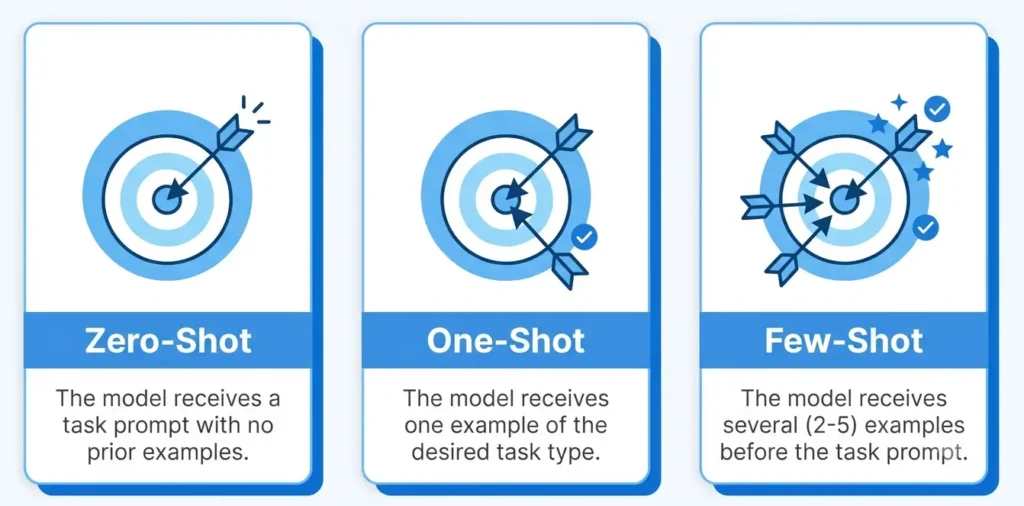
In zero-shot prompting, you simply ask a question without providing any example or context. You do not tell the AI what kind of output you want. You just ask, and the AI gives a response based on its own understanding.
This is the most basic technique. It works for simple questions but may not always give you the exact output you need.
One-Shot Prompting
In one-shot prompting, you provide one example to the AI along with your question. For instance, you might share a JSON structure with specific key-value pairs like city name or country name, and tell the AI that you want the output in exactly that format.
The AI learns from that single example and generates its final output in the same style. One example is enough to guide it in the right direction.
Few-Shot Prompting
Few-shot prompting means giving the AI 3 to 5 different examples. You show it multiple question-and-answer pairs so it understands the pattern. For example:
- This was the question, this was the answer.
- This was the question, this was the answer.
After seeing these examples, the AI reads your actual question and responds in the same format. This technique is very effective when you need consistent, structured output.
Advanced Prompting Techniques

Role Prompting
In role prompting, you define a persona or role for the AI. For example, you tell it to act as a teacher, an engineer, or any other professional. This helps the AI understand what kind of perspective or expertise it should apply when giving a response.
System Prompting
System prompting means setting behavioral guidelines and rules for the AI. A system prompt sets the AI’s behavior, tone, and overall instructions before the conversation begins.
Chain of Thought
Chain of thought is widely used for reasoning tasks. In this technique, you walk the AI through a step-by-step process. You tell it:
- Step 1: Do this
- Step 2: Do this
- Step 3: Do this
In chain of thought prompting, you encourage the AI to work through a problem step by step, which often improves reasoning on complex tasks.
Self-Consistency
Self-consistency is another advanced technique where multiple reasoning paths are explored and the most consistent answer is selected. It helps improve accuracy for complex problem-solving.
Tree of Thoughts
Tree of Thoughts is a prompting technique where the AI explores multiple possible paths or ideas at once, like branches on a tree, before settling on the best response. It is used for advanced, multi-step tasks.
Best Practices for Prompt Engineering
To write effective prompts, follow these best practices:
- Specify things clearly
- Define a role for the AI
- Use action words and verbs
- For complex tasks, use chain of thought and walk through steps
- Give positive instructions rather than only saying what not to do
- Include a few examples so the AI understands what output format you need
- Always define the output structure and format at the end of your prompt
Common Mistakes to Avoid
Many people make these mistakes when writing prompts:
- Giving vague or ambiguous instructions
- Overloading the prompt with too many constraints, making it impossible for the AI to function properly
- Not providing reasoning for complex tasks and skipping chain of thought
- Not adding any examples so the AI has no reference for the expected output
Avoiding these mistakes will significantly improve the quality of your AI outputs.
Disclaimer: This article is based on educational content about AI and prompt engineering. AI tools are constantly evolving and results may vary depending on the platform and model being used. Always verify AI-generated content before publishing or using it professionally.